
Alex Clare-Young
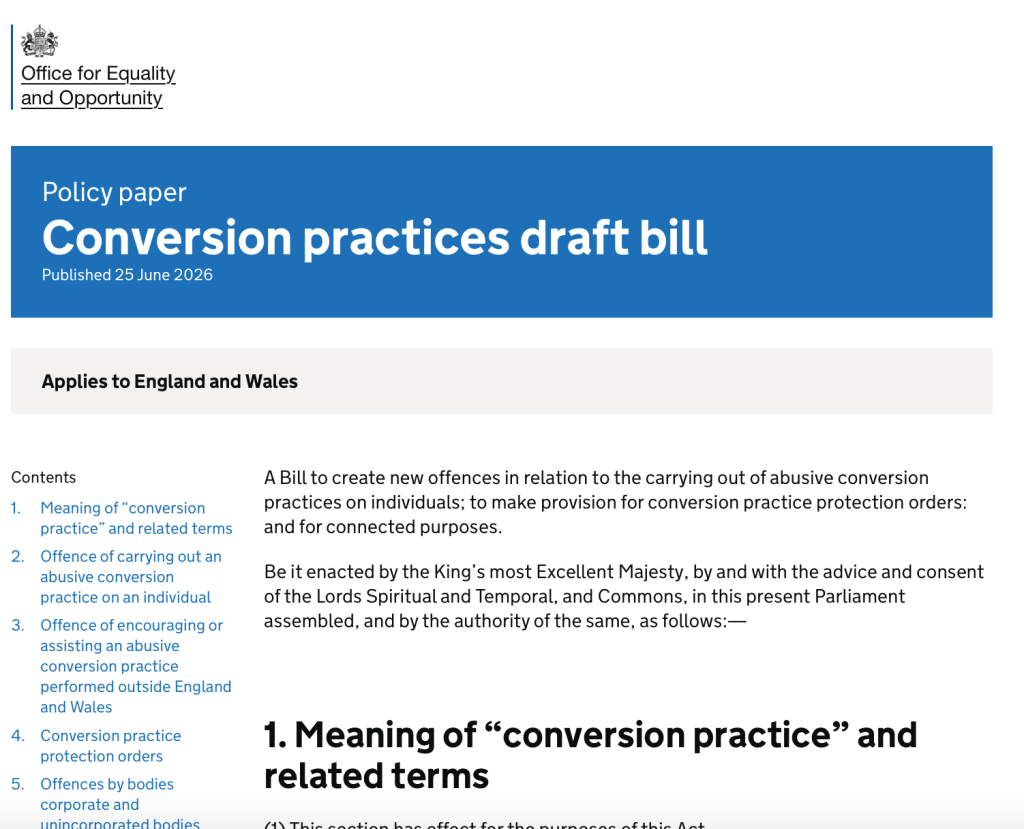
After eight years of broken promises, the UK Government has finally published a Draft Conversion Practices Bill. Published on 25 June 2026, it has been a very long time coming. And yes – it covers trans people. Sort of. That alone is worth pausing to acknowledge, because the previous government explicitly excluded trans people from its proposed legislation in 2023, a decision that caused enormous harm and was roundly condemned by the URC, the Methodist Church, and many others.
So we finally have a bill that names us, (sort of) overs us, and (almost) treats our identities as worth protecting. That is news.
But this is a draft bill, published for pre-legislative scrutiny. There will be a consultation process. And there are serious problems with this draft that the trans community – and our allies – need to name clearly, loudly, and quickly.
What the Bill Gets Right
The bill creates a new criminal offence of carrying out an ‘abusive conversion practice’ – defined as a practice with a predetermined aim of changing, suppressing, or eliminating a person’s sexual orientation or gender identity, which causes serious harm, alarm or distress. It also establishes civil Conversion Practice Protection Orders (CPPOs) and extends liability to corporate bodies – meaning organisations, charities, and churches cannot hide behind institutional structures.
It covers both talking therapies and non-clinical settings. It does not include a blanket religious exemption – a significant decision that Humanists UK and others have specifically welcomed. The Government has recognised, at least in principle, that religious freedom is not a licence to harm.
What the Bill Gets Wrong
Here is where I have to be honest with you, and where I find myself in agreement with TransActual’s devastating analysis, which described the bill as reading ‘like an instruction manual for abuse.’
The bill creates an offence of ‘abusive conversion practice’ – but in doing so, it implies that there are non-abusive conversion practices. There aren’t. The attempt to change, suppress, or eliminate someone’s gender identity is harmful whether it causes clinically measurable ‘serious harm’ or not. The shame, the self-doubt, the fracture in one’s relationship with self and with God – these things do not always produce symptoms that meet a legal threshold. But they are real, and they are wrong.
By building in this distinction, the bill may inadvertently legitimise the type of conversion practice that is most pernicious- the gentle conversations, the pastoral ‘concerns’, the quietly coercive prayer – which in faith contexts is often where the harm actually lives. My own experiences of attempted conversion therapy was via late night conversions and prayers from a church youth worker in a residential setting. Despite causing me severe and lasting harm, that effects me to this day, I don’t think this experience would be covered by the draft bill. You can read more about my experiences here.
https://opentable.lgbt/our-news/2022/4/22/euphoria-the-real-story-otn-co-chair-reflects-on-trans-co…
(Trigger Warning: Please note that this link has references to conversion abuse.)
The healthcare carve-out is a gaping hole
The bill exempts health and social care services from the offence unless the provider has acted ‘far below the standards of care’ – language equivalent to the gross negligence threshold in medical law. This is an extraordinarily high bar.
For trans people, this is particularly alarming. We are living through a period in which ‘gender-exploratory therapy’ – a model that has been credibly criticised as a form of conversion practice in a therapeutic wrapper – is gaining ground in clinical settings. A gross negligence threshold will not catch that. It will catch the most egregious abusers while leaving a whole ‘cottage industry of conversion abusers posing as therapists,’ as TransActual put it, completely untouched.
Faith spaces and prayer: a silence that speaks loudly
The bill does not include an explicit exemption for religious settings – which is good. But it also does not explicitly address what happens in faith spaces at all. Galop’s research documented 52 cases of religion-based conversion practices between 2022 and 2025, including coerced prayer, religious ‘aversion therapy,’ and exorcisms. These practices are real, they are happening in churches, and the bill’s ‘serious harm’ threshold may not catch them, as explained above.
The silence around prayer and faith spaces creates ambiguity that will be exploited – both by those who want to argue their practice is protected, and by the well-meaning churches who simply don’t know whether they are doing harm or not. A strong bill would say clearly: attempting to change or suppress someone’s gender identity through prayer or religious practice is a conversion practice, full stop. This bill does not say that.
What Needs to Happen Next
The pre-legislative scrutiny process will likely take around three months. This is the moment to engage. If you have been subjected to conversion practices – particularly in a faith context – your response to the joint parliamentary committee matters enormously.
Specifically, I would want the committee to hear calls for:
• Removal of the ‘serious harm’ threshold, or at minimum, a much broader definition that captures harm to psychological wellbeing, spiritual life, and relational integrity – not just clinically measurable distress.
• Strengthening of the healthcare carve-out – the gross negligence standard must go. Healthcare professionals should be held to professional standards of care, not near-criminal ones.
• Explicit provision addressing faith contexts – not to exempt them, but to be clear that prayer and pastoral practice intended to change or suppress gender identity are within scope.
• Retention of trans-inclusive scope – scrutiny must not become an opportunity to re-litigate trans inclusion. We are in this bill. We must stay in it.
As a trans minister in a church that has already taken a stand against conversion practices, I believe the Church has a prophetic role to play here – not just to protect its members, but to say clearly to Parliament: the bill you have published is a beginning, not an end. We welcome it. We will hold you to making it stronger.
God of the margins and the threshold,
We give thanks for every step toward protection – for legislators who have listened, for survivors who have spoken, for the long labour of those who refused to let this drop.
And we bring before you those still caught in the gaps: those whose harm will not be deemed ‘serious’ enough, those harmed by institutions that float above the bill, those whose identities are ever more problematised and debated.
May this bill be only a beginning. May the scrutiny be rigorous and the amendments bold. May the church be found on the just side of this history – not as an institution that harms, but as a sanctuary where every body is named beloved.
Amen.
Revd. Dr. Alex Clare-Young is a minister in the United Reformed Church, theologian, speaker, and author of “Transgender. Christian. Human.” (Wild Goose, 2019) and “Trans Formations” (SCM Press, 2024).

